
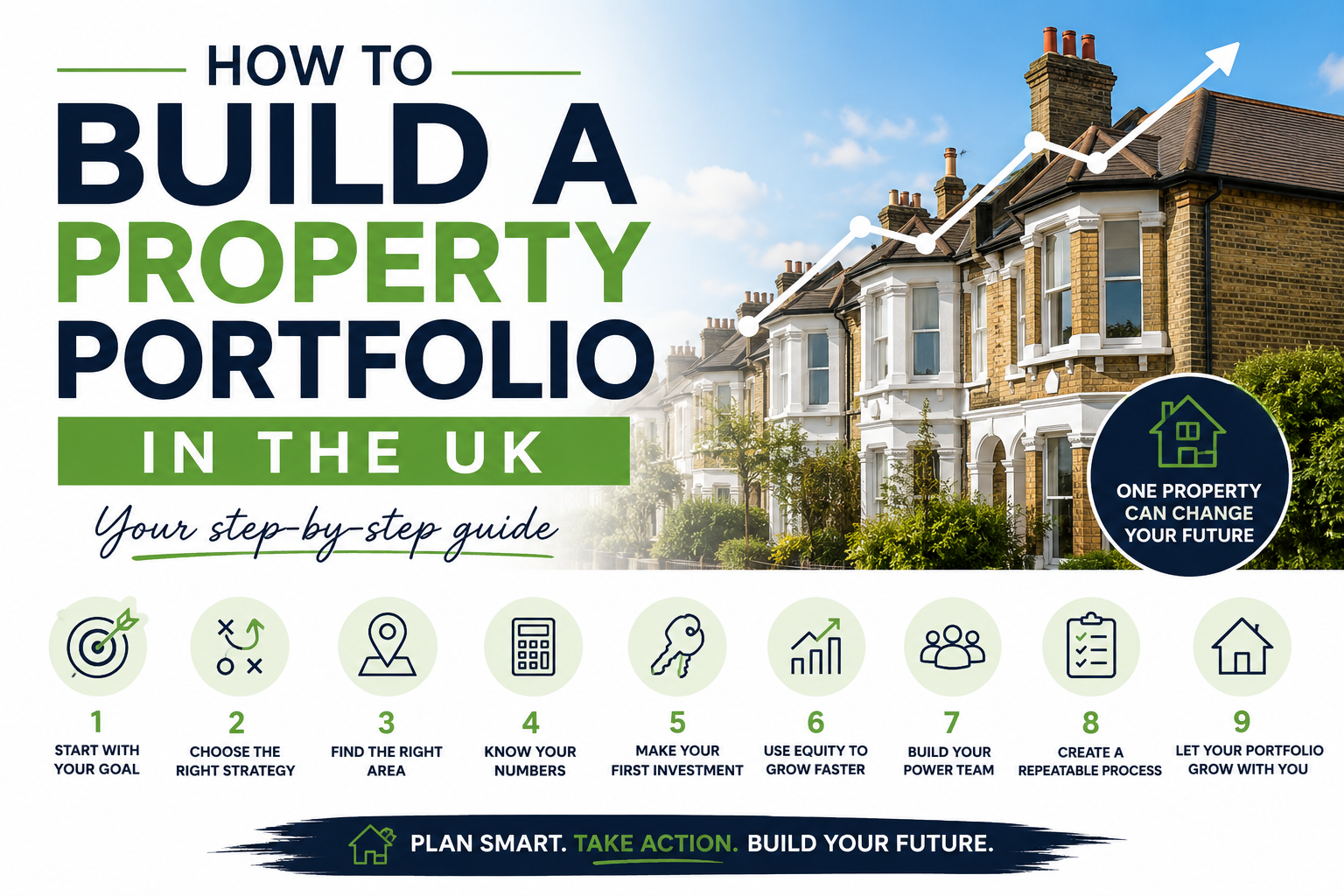
How to Build a Property Portfolio in the UK: Your Step-by-Step Guide
If you’ve ever thought about building a property portfolio in the UK, you may have wondered:
“Where do I actually start?”
The good news is that you don’t need to own ten properties, have a huge amount of money or know everything about property before you begin.
You need a clear plan, the right strategy and the willingness to take consistent action.
Building a property portfolio is something that can be done step by step.
One property can become two.
Two can become three.
And over time, those properties can create an asset base that provides income, potential capital growth and greater financial flexibility.
The key is to start with the right foundations.
Book a call short with me to explore this further. Here’s the link: book now
What Does Building a Property Portfolio Actually Mean?
A property portfolio is simply a collection of investment properties.
It might be one property today, two or three properties in a few years, or something much larger over the long term.
But building a portfolio isn’t about collecting as many properties as possible.
It’s about creating the right portfolio for you.
Your portfolio might be designed to:
- Generate additional monthly income
- Build long-term wealth
- Create an income for retirement
- Give you greater financial freedom
- Provide assets for your family
- Create multiple income streams
- Eventually replace some or all of your earned income
There isn’t a single definition of a successful property portfolio.
Your portfolio should be built around your goals.
And that is where your journey should begin.
Step 1: Start With Your Goal
Before you start searching for properties, decide what you want property investing to achieve.
Imagine where you’d like to be in five, ten or fifteen years.
Perhaps you want £1,000 a month of additional income.
Perhaps your target is £3,000.
Maybe you want to build enough assets to create an income for life.
Or perhaps your main objective is to build wealth that you can eventually pass on to your family.
Whatever your goal, give it some thought.
Because once you know where you want to go, it becomes much easier to work out how to get there.
A good property investment plan starts with the destination.
Step 2: Find the Strategy That Fits You
One of the exciting things about UK property investing is that there isn’t just one way to do it.
You have choices.
Some investors prefer traditional buy-to-let.
Others enjoy finding properties where they can add value.
Some focus on HMOs.
Others use serviced accommodation.
There are also strategies such as lease options, rent to rent, social housing and buying at auction.
Some of the strategies you could explore include:
Buy-to-Let
A straightforward approach where you purchase a property and rent it to tenants.
The potential benefits can include rental income and long-term capital growth.
Buy, Refurbish and Refinance
Purchase a property with potential, improve it and then refinance based on its new value.
This can be a powerful way of creating additional equity and potentially using that equity to help fund future purchases.
HMOs
House in Multiple Occupation properties can provide attractive rental income where there is strong demand for rooms.
They can be particularly interesting in areas with large student, professional or workforce populations.
Serviced Accommodation
This involves providing short-term accommodation rather than a traditional long-term rental.
In the right location and with the right numbers, it can provide an alternative income model.
Lease Options
A lease option can allow an investor to control a property with an agreed option to purchase it in the future.
This can be useful in certain circumstances, although the legal structure needs to be properly understood.
Rent to Rent
Rather than buying a property, an investor agrees with the owner to take control of the property and operate it.
This can potentially provide a way to gain experience and generate income without purchasing the property itself.
Buying at Auction
Auctions can provide access to a wide range of properties, including properties where there may be opportunities to add value.
The important thing is to research the property thoroughly before bidding.
The exciting part is that you don’t have to use every strategy.
Your job is to find the one — or combination — that fits your goals, finances, skills and lifestyle.
Step 3: Find an Area Where the Numbers Work
Once you know your strategy, you can start looking for the right locations.
This is where property investing becomes really interesting.
You’re not simply looking for somewhere with cheap houses.
You’re looking for somewhere where people want to live and where your chosen strategy works.
Look at:
- Rental demand
- Average rents
- Property prices
- Employment
- Transport links
- Universities
- Hospitals
- Schools
- Regeneration
- Local amenities
- Population growth
- New developments
You don’t have to invest on your doorstep.
One of the great things about property investing is that you can research markets across the UK and find areas that fit your strategy.
The right area can make a huge difference to your investment.
Step 4: Learn to Spot a Good Investment
Once you’ve identified your strategy and your area, you can start looking at individual properties.
This is where your research starts to pay off.
A property can look fantastic on the outside, but the real opportunity is in understanding the numbers.
There are three numbers I would always want to understand before making an offer:
1. What will I pay?
Look beyond the purchase price.
Consider the deposit, Stamp Duty, legal costs, mortgage costs, refurbishment and other purchasing expenses.
2. What rent will it achieve?
Research comparable properties.
Speak to local letting agents.
Find out what tenants are actually prepared to pay for a property like yours.
3. What could it be worth?
If you’re adding value, understand what the property could realistically be worth once the work is completed.
These three numbers give you the foundation for making an informed decision.
Know your numbers and you can make decisions with confidence.
Step 5: Make Your First Investment the Start of Something Bigger
Your first property doesn’t have to be perfect.
It needs to be right for your plan.
Once you’ve purchased your first property, you’ve gained something incredibly valuable:
Experience.
You’ve gone through the process.
You’ve found a property.
You’ve negotiated.
You’ve arranged finance.
You’ve completed the purchase.
You’ve dealt with tenants, refurbishment or letting.
You’ve learned what works.
And that experience can make your second investment easier.
Then your third.
Then your fourth.
This is how a portfolio can grow.
Step 6: Use the Power of Equity
One of the reasons property can be such an interesting long-term investment is the potential to build equity.
Imagine you buy a property for £180,000.
Over time, you improve the property, the market grows, or both happen together.
The property may eventually be worth more than you paid for it.
That increase in value creates equity.
Depending on your circumstances and lending position, you may eventually be able to refinance and release some of that equity.
That capital could potentially help fund another investment.
This is one of the ways investors can gradually move from:
Property 1 → Property 2 → Property 3 → Property 4
Instead of having to save the entire deposit for every property from scratch.
Of course, refinancing depends on the property value, mortgage criteria, affordability and your individual circumstances.
But the principle is powerful:
Your existing assets can potentially help you build your future assets.
Step 7: Build Your Property Power Team
You don’t have to become an expert in everything.
In fact, you shouldn’t try to.
Successful property investors build relationships with people who can help them make better decisions.
Your property team might include:
- Mortgage broker
- Accountant
- Solicitor
- Estate agent
- Letting agent
- Surveyor
- Builder
- Architect
- Planning consultant
- Insurance broker
- Property manager
The better your team becomes, the easier it can be to move forward.
And something else happens too.
You start to become known.
Agents know what you’re looking for.
Mortgage brokers understand your plans.
Builders understand your expectations.
Other investors start bringing opportunities to you.
Your network can become one of your greatest property assets.
Step 8: Create a Repeatable Process
The real excitement comes when you stop thinking about property as a one-off purchase and start thinking about it as a process.
You want to be able to repeat what works.
For example:
Find the area → Find the property → Analyse the numbers → Make the offer → Complete the purchase → Add value → Rent/refinance → Repeat
The more experience you gain, the better you can become at each stage.
You don’t need to know everything on day one.
You simply need to keep improving.
Step 9: Let Your Portfolio Grow With You
Your first property might be very different from your tenth.
And that’s okay.
As your knowledge, experience and financial position develop, your strategy can develop too.
You might start with a simple buy-to-let.
Then discover that you enjoy refurbishment.
Perhaps you move into HMOs.
Maybe you eventually combine several strategies.
Your portfolio doesn’t have to be planned perfectly from day one.
It can evolve as you grow.
How Many Properties Do You Need?
This is one of the most common questions people ask.
The answer?
As many as you need to achieve your goal.
If your objective is to generate £2,000 a month in additional income, you can work backwards from that target.
If your properties generate an average of £500 a month net income, you may need four properties.
If they generate £1,000, you may need two.
The exact figures will depend on the properties, financing, costs and strategy.
But this approach gives you something much more useful than a random target of “I want ten properties.”
You have a destination.
And once you have a destination, you can create a route.
Can You Start With a Small Amount of Money?
You don’t necessarily need a huge amount of capital to start exploring property investing.
The amount of money you need will depend on your strategy and circumstances.
Traditional buy-to-let generally requires a deposit and purchasing costs.
But there are other strategies that can potentially require less capital, including rent to rent, lease options and certain joint venture arrangements.
You can also potentially create opportunities by finding properties where you can add value.
The important thing is to understand exactly how the deal works.
There is no magic formula.
But there are different ways of structuring property deals.
And understanding those different options can open up possibilities you may not have considered.
The Most Important Investment Is Your Knowledge
Before you invest thousands of pounds into property, invest time into understanding what you’re doing.
Learn how to:
- Research an area
- Analyse a deal
- Calculate rental income
- Understand finance
- Assess refurbishment costs
- Negotiate
- Find good professional advisers
- Understand the risks
- Build relationships
- Create a long-term plan
The more you understand, the more confident you can become.
And confidence doesn’t come from believing every property is going to work.
It comes from knowing how to assess whether a property works for you.
Building a Property Portfolio Is a Journey
There is something very satisfying about watching a property portfolio develop over time.
You start with an idea.
Then you take action.
You find your first property.
You learn from it.
You buy your next one.
You build relationships.
You become better at analysing deals.
You become more confident negotiating.
And gradually, you begin to see the bigger picture.
You’re not simply buying houses.
You’re building something.
Something that could provide income.
Something that could grow in value.
Something that could give you more choices in the future.
Something that could potentially become a legacy for your family.
Start With Clarity. Then Take Action.
You don’t need to know exactly how you’re going to build a ten-property portfolio before you buy your first property.
You need to know your next step.
Start with your goal.
Choose a strategy.
Find an area.
Learn the numbers.
Build your team.
Find your first opportunity.
Then keep moving forward.
Property investing is rarely about one big decision.
It’s about making lots of good decisions consistently over time.
And that’s why I believe building a property portfolio is achievable for far more people than they realise.
You don’t need to rush.
You don’t need to follow someone else’s strategy.
You don’t need to buy every deal that comes along.
You simply need a plan that works for you — and the discipline to follow it.
Start with clarity. Build with confidence. Grow one property at a time.
Book a call short with me to explore this further. Here’s the link: book now